Art History: Comparing the works of the Colonizers vs. the Colonized
A Digital Exhibition by Celeste Manguso
Group Two

Group Two: The Spanish and the Maya
The Spanish
Pre-Colonial:
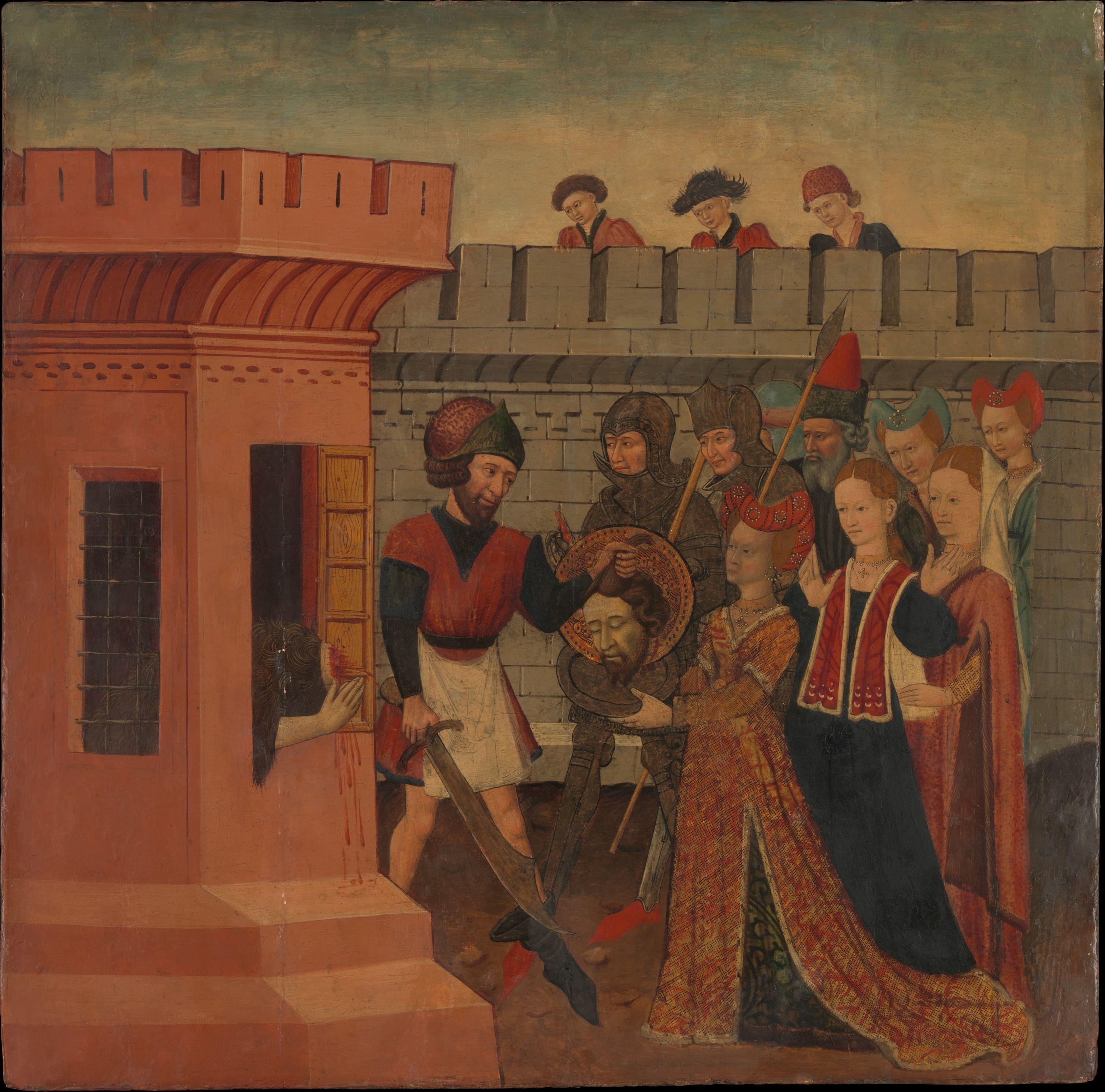
Unknown, Spanish (Catalan), Mid 15th Century, Tempera and gold on wood, 'The Beheading of Saint John the Baptist'
Post-Colonial:
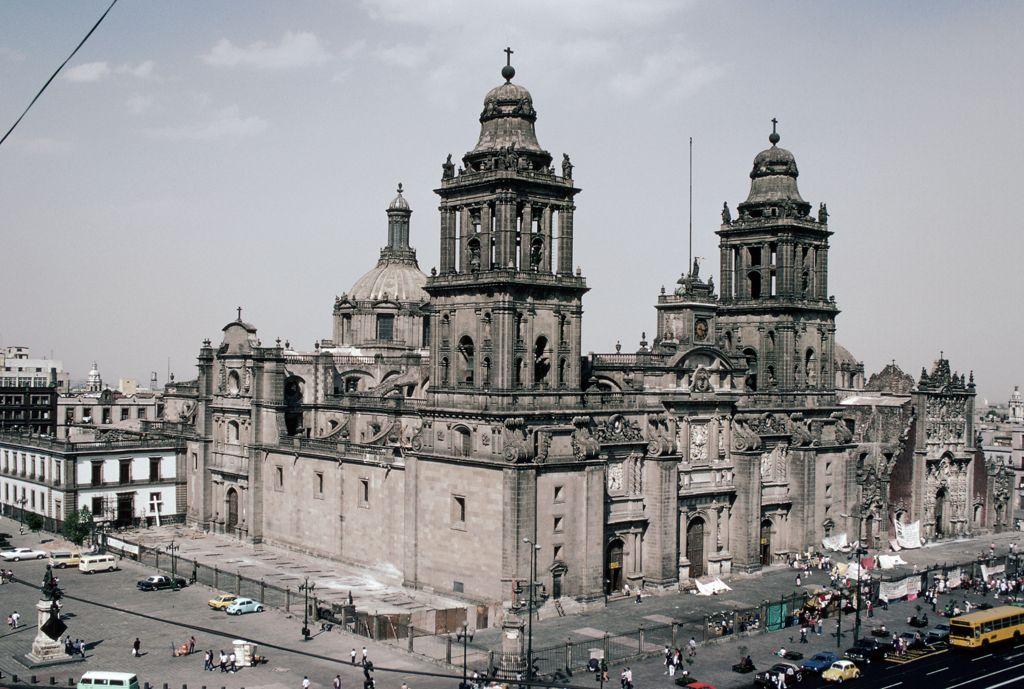
C. De Arciniega and J.M. De Aguero, Spanish, 1563-ca. 1812, Iberian Baroque Cathedral, 'Mexico City Metropolitan Cathedral'
The Maya
Pre-Colonial:
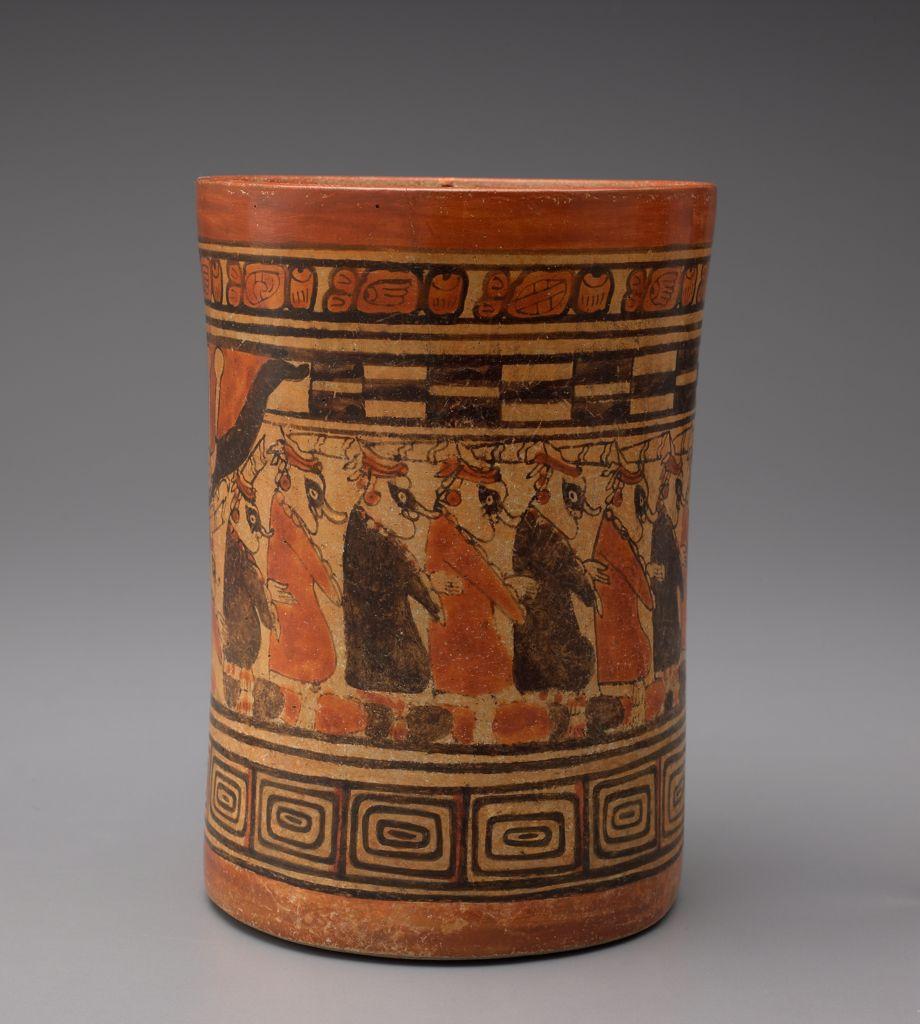
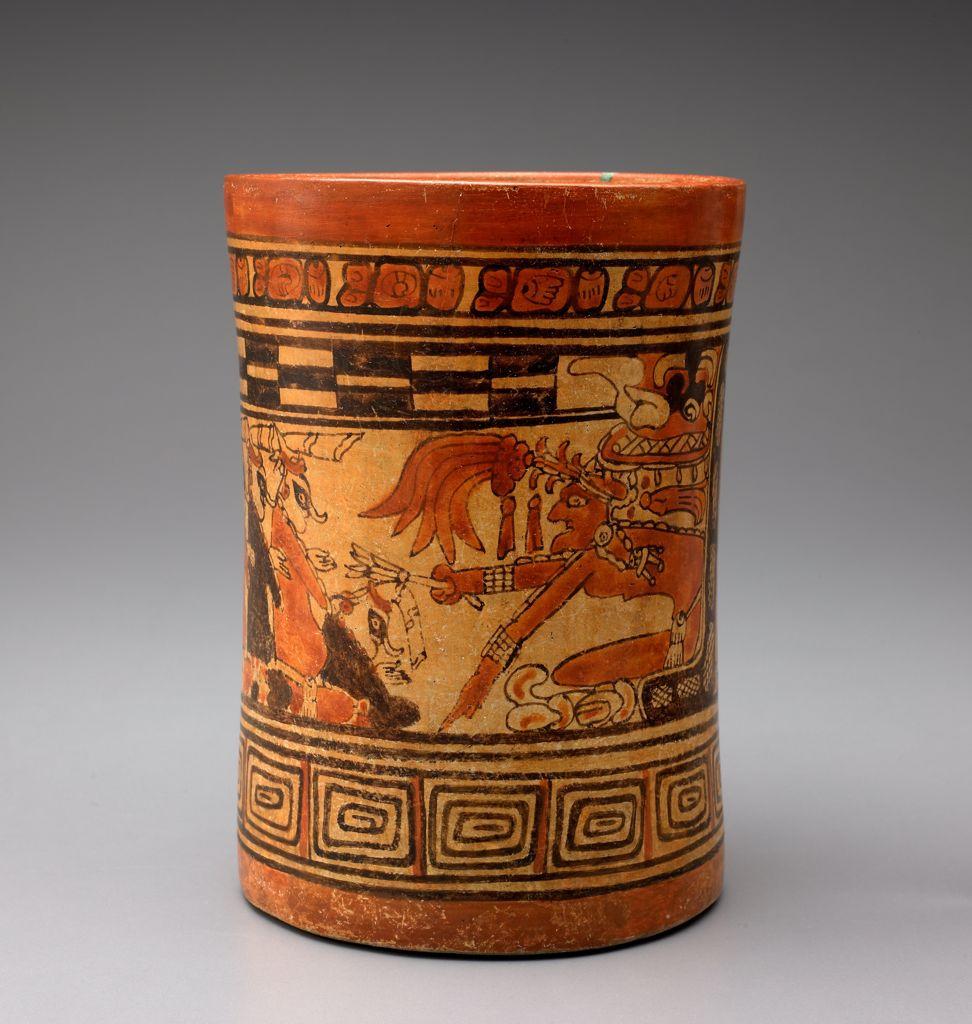
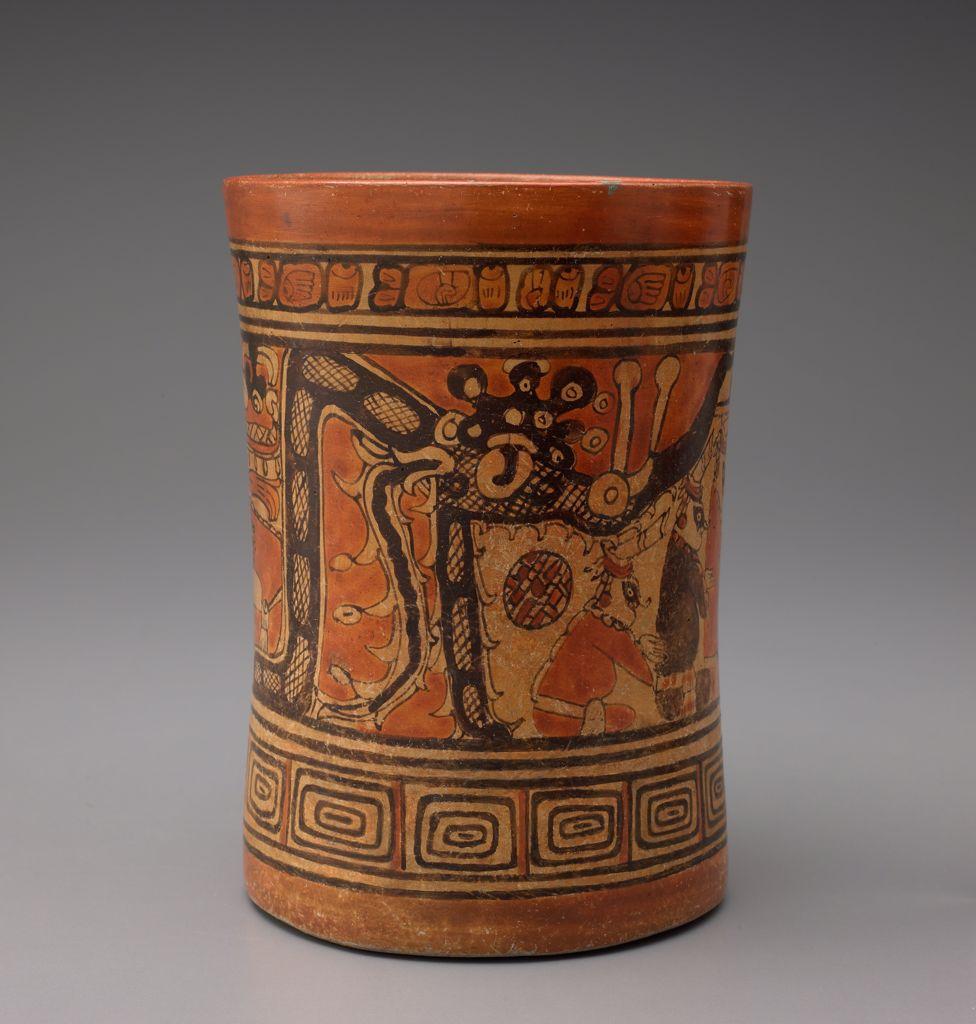
Unknown, Mayan, ca. 600-900, Ceramic with colored slip, 'Cylinder vase depicting scribes in the Underworld'
Post-Colonial:
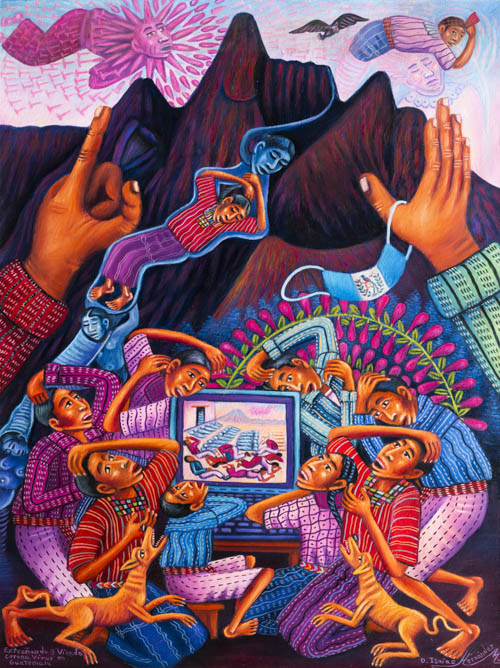
Diego Isaias Hernández Mendez, Mayan, 2020, Oil on Canvas, 'Extrañando y Viendo Coronavirus en Guatemala (Feeling Uncomfortable and Seeing Coronavirus in Guatemala)
Write-Up:
The Spanish:
The first work from the Spanish we are looking at today depicts the beheading of Saint John the Baptist, a biblical event in which John the Baptist was beheaded on the orders of the Roman Emperor at the time. This is one of many artistic depictions of this event, showing an executioner having just beheaded Saint John, handing his head on a silver platter to an aristocratic woman. Interestingly, all the characters in this rendition are wearing contemporary Spanish clothing, rather than Roman clothing from the time of John's execution. This is not particularly uncommon for religious paintings, however. Another interesting note is that this piece was produced in Catalonia, a place with it's own history of colonization by the Spanish, and the site of modern-day debates over the independence and self-determination of the Catalonian people, including an attempt by the Catalonian government (declared illegal by Spanish authorities) to declare independence in 2017.
The second work we are looking at is the Metropolitain Cathedral of Mexico City. This cathedral was built in Mexico City from 1563-1812, and is just one of many examples of Spanish colonial architecture throughout Latin America. It is also an example of the Spanish spread of Catholicism across the lands of North, South, and Central America. Mexico City itself is built atop the site of the Aztec city of Tenotchitlan, making this Cathedral a powerful symbol of Spanish Colonialism. Spain first carried out a violent war against the Aztec people, and then established a colony upon their lands, finally building a massive Cathedral in the Spanish architectural style atop the former site of the Aztec capital. It sends a clear message about Spanish Colonist's disregard for the people of Mesoamerica.
The Mayans:
The first work of Mayan art we are examining is a cylindrical ceramic vase depicting multiple robed figures in a procession. At the back of the precession a dragon-like creature threatens to eat them, while at the front an important-looking figure points a reed or other leafy object at them, causing one of them to kneel. The title indicates that these are scribes in the Mayan Underworld. It is interesting that it is very stylized, as well as having a lot of repeating geometric motifs. It is a piece of advanced, well-crafted ceramic, indicating knowledge of advanced ceramic techniques by the Mayan civilization as of at least 600-900 CE. It also indicates knowledge of pigmentation techniques, as there are multiple colors featured on the piece (tan, orange, red, and black). It likely would've been surprising to the Spanish to encounter advanced civilzations which they did not know about, and whose religious and social practices were very different. The Mayans would've had the same shock when Spanish ships arrived on their shores. Unfortunately, it was not treated as a meeting of equals by the Spanish.
The second Mayan work we are looking at is a very modern painting, produced by a Mayan man in Guatemala in 2020. It references the COVID-19 pandemic, and it's emotional effect as seen from the artist's perspective as a Mayan in Guatemala. The piece again makes heavy use of stylized forms, differing quite a bit from realistic depictions of human beings or animals. At the top of the piece, it appears that the virus itself has been given a face, seen flying through the sky in a dragon-like form (similar to the dragon-like creature seen before). In the foreground of the image, a group of people (possibly a family) are crowded around a desktop computer, looking at an image of the dead piled up outside a warehouse. It also appears that multiple spirits may be ascending into the sky next to the group of people. Also in the sky is a set of large, disconnected hands (almost the point-of-view of the viewer of the work itself), which point to the virus in the sky with one hand and hold up a mask with the other hand. It is a very interesting work, depicting the effects of a worldwide pandemic from a perspective I imagine not may people consider, that being of an indigenous Mayan living in Guatemala.
The Interaction:
The Spanish and the Mayans first met in the early 16th century, and the Spanish soon established their first trading colonies in the "New World". They would soon abandon their initial plans to establish semi-peaceful trading communities, and instead set their sights on conquest and violent warfare. They seeked to sieze by force land, resources, and slaves from Mesoamerica while converting it's peoples to Catholicism. The spanish would wage multiple wars upon various subgroups of the Mayans, alongside other Mesoamerican cultures (such as the Aztecs). The Spanish and various Mayan communities warred throughout the period of 1520-the 1600's. Some Mayan communities managed to retain their independence until as late as 1697, while others fell much earlier. Once a Mayan community fell to the Spanish, they would see their gold plundered, their temples desecrated, Catholic missions established, and native religious practice outlawed. Those who refused to catholicize and otherwise adapt to a Spanish way of life would be punished by enslavement and torture. Much of the information we have about the Mayans today is unfortunately obtained under duress by means of torture, making it difficult to determine how accurate it is. The Mayans, of course, wrote about the Spanish invasion from their prespective as well, and some of these texts remain as well.
Conclusion:
The Mayans were never entirely defeated. The Spanish may have put an end to the Mayan civilization as a politcal entity, but despite their attempts, they could not entirely kill Mayan culture and civilization. Mayan-led revolts against Spain and it's successor governments would occur throughout the 18th, 19th, and 20th centuries. Some Mayans continued their religious practices long after the arrival of the Spanish. Even after the Spanish conquerors had swept through an area, Mayans would return and rebuild a village behing Spanish lines. Mayan art continued to be created as well, as demonstrated perfectly by the choice of post-colonial art seen above. The story of the Mayans is one of a violent end, but it is also one of reslience, survival, and resistance to the forced cultural ideals of the Spanish government in South, Central, and North America. The Mayan culture lived on, even as Catholic cathedrals were built upon Mesoamerican lands, as their leaders were executed and their villages burned, as their peoples subjugated and their riches looted, and as the Spanish themselves were forced out of the Americas, replaced by it's successor nations. The Mayans have survived Spanish colonial rule, European epidemics, Catholicism being forced upon them, enslavement, and later exploitation by foreign and domestic powers once the Spanish had left. This took the form of American fruit and sugar plantations, cartel violence, CIA meddling in political affairs, and corrupt governments, among other struggles. The Mayans have carved their place into the land, and even in the face of all of this, they remain.


